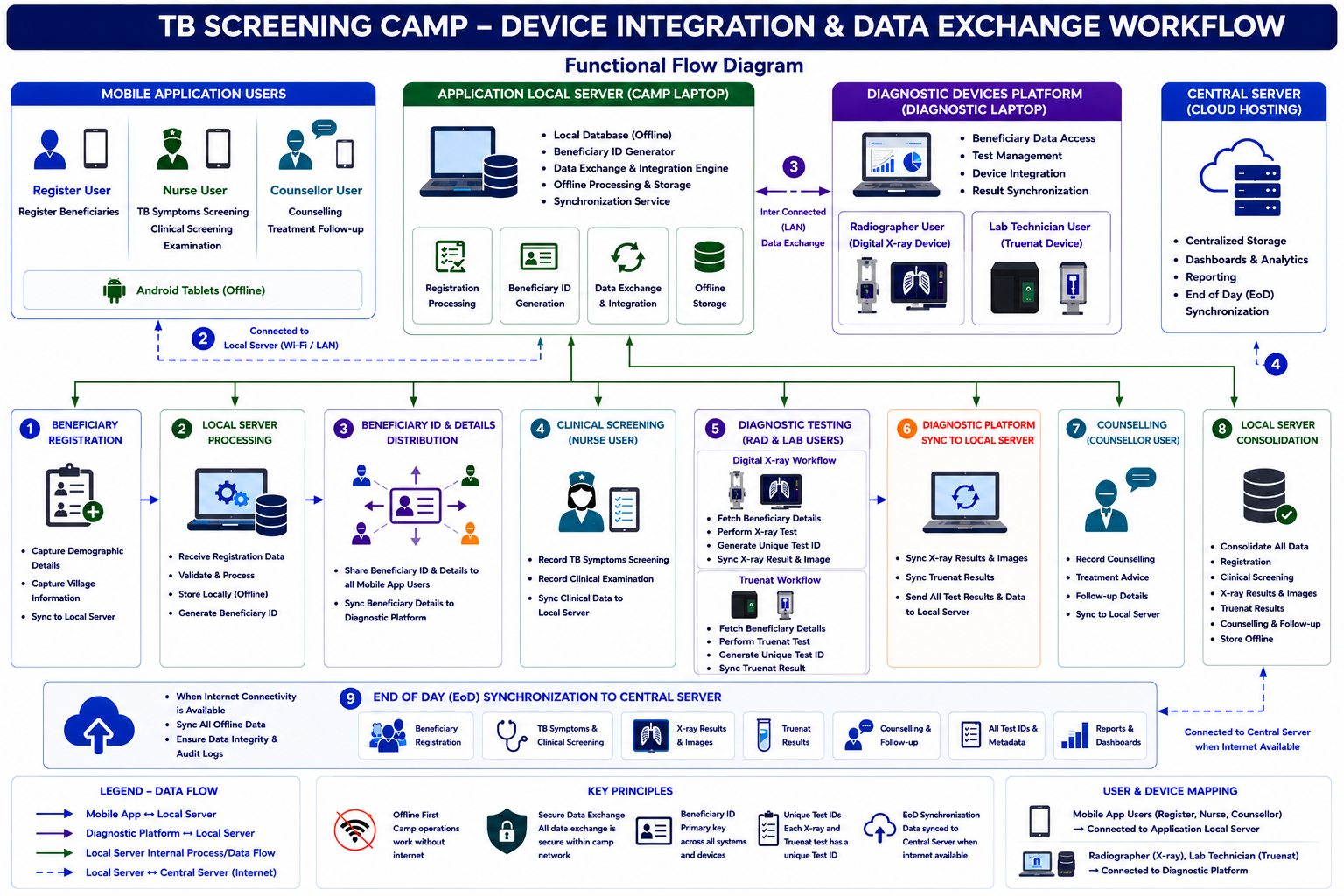
Overview
Digital TB Screening App – Device Integration
The Digital TB Screening Camp Solution is designed to support end-to-end tuberculosis (TB) screening activities conducted through village-based health camps. The solution enables seamless integration between the TB Screening Mobile Application, Application Local Server, Diagnostic Devices Platform, Digital X-ray Device, Truenat Device, and the Central Cloud Server.
The platform supports beneficiary registration, TB symptom (verbal) screening, clinical examination, radiological investigation, molecular diagnostic testing, counselling, and treatment follow-up within a completely offline camp environment.
During the screening camp, beneficiaries are registered using the TB Screening Mobile Application. Individuals identified as presumptive TB cases are referred for Chest X-ray examination and Truenat molecular testing within the same camp. All data generated during these activities is exchanged securely through the Local Server and Diagnostic Devices Platform without requiring internet connectivity.
The architecture separates application services from diagnostic device services by introducing a Diagnostic Devices Platform, which acts as an intermediary integration layer between diagnostic devices and the Application Local Server.
At the end of the camp, all beneficiary records, clinical information, diagnostic test results, and counselling data are synchronized from the Local Server to the Central Cloud Server whenever internet connectivity becomes available.
System Architecture Overview
The digital solution comprises the following components:
The architecture supports offline-first operations while ensuring secure data exchange between all applications and diagnostic devices deployed during the camp.
Functional Requirements
FR-01: Diagnostic Device Connectivity
The Digital X-ray Device and Truenat Device shall be connected to the Diagnostic Devices Platform Laptop for diagnostic data exchange.
FR-02: Mobile Application Connectivity
All TB Screening Mobile Application devices shall connect to the Application Local Server Laptop through the camp's local network.
FR-03: Platform-to-Platform Integration
The Diagnostic Devices Platform Laptop and Application Local Server Laptop shall communicate through a secure local network to exchange beneficiary and diagnostic data.
FR-04: Central Server Connectivity
The Application Local Server shall synchronize data with the Central Cloud Server whenever internet connectivity becomes available.
FR-05: Offline Mobile Application
The TB Screening Mobile Application shall function completely in offline mode without dependency on internet connectivity.
FR-06: Offline Local Server
The Application Local Server shall process, store, and exchange data entirely in offline mode during camp operations.
FR-07: Mobile Application Users
The following users shall access the TB Screening Mobile Application:
These users shall exchange data exclusively through the Application Local Server.
FR-08: Diagnostic Device Users
The following users shall operate diagnostic devices:
The Digital X-ray Device and Truenat Device shall communicate exclusively with the Diagnostic Devices Platform.
FR-09: Beneficiary Registration
The Register User shall register beneficiaries by capturing:
FR-10: Registration Synchronization
The Mobile Application shall synchronize beneficiary registration details with the Application Local Server.
FR-11: Beneficiary Processing
The Application Local Server shall validate and process all beneficiary registration records received from the Mobile Application.
FR-12: Beneficiary ID Generation
The Application Local Server shall generate a unique Beneficiary ID for every registered beneficiary.
FR-13: Beneficiary ID Synchronization
The generated Beneficiary ID shall be synchronized back to the Mobile Application.
FR-14: Beneficiary Data Distribution
The Application Local Server shall distribute Beneficiary IDs and beneficiary details to:
The Diagnostic Devices Platform shall further make beneficiary details available to:
Each user shall be able to search and select beneficiaries relevant to their assigned workflow.
FR-15: TB Symptom Screening
The Nurse User shall capture:
FR-16: Clinical Data Synchronization
The Nurse Module shall synchronize all clinical information to the Application Local Server using the Beneficiary ID as the primary identifier.
FR-17: Application Local Server
The Application Local Server shall function as the central application data exchange platform for:
FR-18: Diagnostic Devices Platform
The Diagnostic Devices Platform shall function as the central integration platform for diagnostic devices, including:
FR-19: Beneficiary Search
The Radiographer User shall retrieve beneficiary details from the Diagnostic Devices Platform.
FR-20: X-ray Examination
Upon completion of the X-ray examination:
FR-21: X-ray Result Synchronization
The Digital X-ray Device shall synchronize the following information to the Diagnostic Devices Platform:
FR-22: Beneficiary Search
The Laboratory Technician shall retrieve beneficiary details from the Diagnostic Devices Platform.
FR-23: Truenat Examination
Upon completion of Truenat testing:
FR-24: Truenat Result Synchronization
The Truenat Device shall synchronize the following information to the Diagnostic Devices Platform:
FR-25: Diagnostic Platform Data Exchange
The Diagnostic Devices Platform shall synchronize all diagnostic data with the Application Local Server, including:
FR-26: Counselling and Follow-up
The Counsellor User shall capture:
The captured information shall be synchronized to the Application Local Server using the Beneficiary ID.
FR-27: Consolidated Beneficiary Record
The Application Local Server shall maintain a consolidated beneficiary record containing:
All information shall be stored locally throughout camp operations.
FR-28: Central Server Synchronization
At the End of Day (EoD), the Application Local Server shall synchronize all offline data with the Central Cloud Server whenever internet connectivity becomes available.
The synchronization shall include:
High-Level Integration Workflow
Key Design Principles