
General Check-up gives a Mitanin one place in Disease Control to record any complaint and refer the person to the HWC, so every referral is captured and counts towards activity 26.
1. Document Overview
Clickable prototype:General-Checkup-Prototype-v0.6_1.html (attached to this page). Download it and open it in any browser. It runs on your machine, no install needed. It shows the Disease Control screen with 3 tiles, the plain-language General Check-up form, Refer to Facility, the HWC Referred List, the follow-up form and the activity 26 count. All people in it are invented.
Field | Detail |
|---|---|
Module | Disease Control, General Check-up sub-module |
Application | Mitanin app (FLW), Chhattisgarh |
Target users | Mitanin. The CHO or MO at the HWC receives the referral. The Mitanin Trainer and ANM verify the monthly claim. |
Primary audience | Product managers, engineering and backend teams, QA, UI/UX, programme team |
Phase | Phase 1 |
Platform | Android mobile application |
Incentive linked | Activity 26, Referring 10 or more cases monthly to the HWC, Rs 400 (AMM-2252). A referral to the HWC, PHC, CHC, Medical College or District Hospital counts. A beneficiary counts once per month. |
Source of the ailment list | Box 2.2, Expanded Range of Services (SHSRC indicative list, 12 service groups), and the common diseases list from Pithora. All 12 groups are placed. See Appendix A. |
Related BRDs | Mitanin Trainer and ANM Incentive Verification Module BRD, Mental Health Module BRD, mHWC Elderly and Palliative Health module BRD, BRD for FLW Mobile App |
Author | Ritam Dubey, BSA |
Status | Draft for review |
Revision history
Date | Version | Author | Approved by | Change reference |
|---|---|---|---|---|
8 Oct 2026 | 0.1 | Ritam Dubey | Pending | First draft |
8 Oct 2026 | 0.2 | Ritam Dubey | Pending | How it was noted and Advice given removed. Referral levels set: HWC, PHC, CHC, Medical College, District Hospital. |
8 Oct 2026 | 0.3 | Ritam Dubey | Pending | Clickable prototype linked at the top. Developer swimlane added to Section 6. |
9 Oct 2026 | 0.4 | Ritam Dubey | Pending | Field confirmation from Pithora added to Section 11. A referral at any of the five levels counts for activity 26. |
10 Oct 2026 | 0.5 | Ritam Dubey | Pending | Button renamed Refer to Facility. Other opens a mandatory text box. Communicable disease and NCD referrals move to their own tiles. Ailment names rewritten in plain words and merged with the field's common diseases list. Dynamic form approach added for developers. A beneficiary counts once per month. Prototype and swimlane rebuilt. |
12 Oct 2026 | 0.6 | Ritam Dubey | Pending | Referral levels only (no named hospital list). Master edited by controlled sheet upload. New Refer action in the NCD and Communicable Diseases tiles (FR16) deferred to a later release. The 3-tile screen stays in scope. |
2. Background and Problem
A Mitanin identifies a person with a complaint or a known condition and sends them to the Health and Wellness Centre (HWC). Activity 26 pays Rs 400 a month for 10 or more such referrals. Mitanins told Nikhil Padhan (8 Oct 2026) that they refer High BP, Diabetes, TB, fever, cough, cold and other OPD cases and count all of them towards this activity. Jaswant Kumar's Pithora field report (8 Oct 2026) raises the same gap. The point first reached the BSA team in July.
Disease Control in the app today is a flat list of 7 programme tiles: NCD, Malaria, Kala Azar, AES/JE, Filaria, Leprosy and Tuberculosis (TB).
Problems
There is no place in Disease Control to record a referral for a general complaint, or for a condition such as High BP or Diabetes.
The Mitanin must know which programme a complaint belongs to before she can start. Most complaints belong to none.
Referrals that are not recorded cannot be counted, so the Mitanin loses an incentive she has earned in the field.
Most ailments in the 12 HWC service groups have no clear home in the app (Appendix A closes this).
3. Goals
Category | Goal | Description |
|---|---|---|
Coverage | Cover every listed ailment | Every ailment in the 12 HWC service groups, and the common diseases the field asked for, has a defined home in the app, either in General Check-up or in a module that already owns it (Appendix A). |
Simplicity | One front door | The Mitanin starts at General Check-up for a general problem. The names she sees are plain, everyday words. Communicable diseases and NCDs are referred from their own tiles. |
Incentive accuracy | Count every beneficiary once | Each referral, to the HWC or to a PHC, CHC, Medical College or District Hospital, is recorded. Each beneficiary referred in a month counts once towards activity 26, in the month of the referral date. |
Continuity | Close the loop | The Mitanin records what happened after the referral, including whether the HWC referred the person further. |
Adoption | Track usage | Share of Mitanins using General Check-up each month, referrals per Mitanin, and share of referrals with a recorded follow-up. |
4. Users
Role | What they do with General Check-up |
|---|---|
Mitanin | Primary user. Records the complaint, refers the person to the HWC, and records the follow-up. Sees only the beneficiaries in her own area. |
CHO or MO at the HWC | Receives the referral, treats the person, and decides on any onward referral. Works in the HWC app, outside this module. The Mitanin app only records the outcome. |
ANM | Reviews the Mitanin's activity 26 claim in the monthly verification module, at activity and beneficiary level. |
Mitanin Trainer | No role here. Her four reviewed activities (23, 24, 25, 40) do not include activity 26. |
5. Scope
Disease Control changes from 7 tiles to 3. General Check-up is built in this BRD. The other two tiles are only regrouped. Nothing inside them changes in this release.
Tile | What it holds | Status |
|---|---|---|
General Check-up | Any general problem that needs a quick check and a referral to a facility. Communicable diseases and NCDs are not listed here. | New. This BRD. |
Non-Communicable Diseases | The NCD tile as it is today, including CBAC screening. | Existing, moves under the new layout. No change inside. |
Communicable Diseases | Malaria, Kala Azar, AES/JE, Filaria, Leprosy and TB. | Existing, move under one tile. No change inside. |
In scope
The General Check-up tile and its beneficiary list.
The 3-tile Disease Control screen (FR1).
A dynamic ailment form for General Check-up, held as editable master data so it can change without an app release (FR12). Ops changes it through a controlled sheet upload.
Ailment names and labels in plain everyday words (FR15).
Routing of a pregnancy, newborn, family planning or cataract problem to the module that already owns it.
Referral to a facility (HWC, PHC, CHC, Medical College or District Hospital) using the existing refer form, and follow-up using the existing HWC Referrals list.
Counting of these referrals for activity 26, one count per beneficiary per month.
Appendix A, which states where every listed ailment sits.
Out of scope
A new Refer to Facility action inside the NCD and Communicable Diseases tiles (FR16). It is planned for a later release. Until then, those cases stay on the referral paths those modules have today.
Clinical decisions at the HWC, including the rules for referring onward to a higher facility. The CHO or MO owns these.
Other changes inside the NCD and Communicable Diseases modules.
The named government hospital list. The Mitanin picks one of five levels.
An admin screen for the ailment master.
Changes to incentive amounts. Activity 26 stays at Rs 400 for 10 or more beneficiaries a month.
The HWC-side app (mAAM). See the related Mental Health and Elderly and Palliative BRDs.
The Home screen's General OPD Care List tile. It is redundant and has no link to General Check-up.
Recording advice or treatment given by the Mitanin. This is outside her scope, so the app does not record it.
6. General Check-up Flow
The Mitanin starts at General Check-up for a general problem. For a communicable disease or an NCD she stays in that tile, as today. The app helps her refer to a facility and later close the loop. The swimlane below is the build reference for developers. It shows five lanes (Beneficiary, Mitanin, Mitanin app, Server, HWC) and 13 steps, and each step carries the requirement ID it implements.
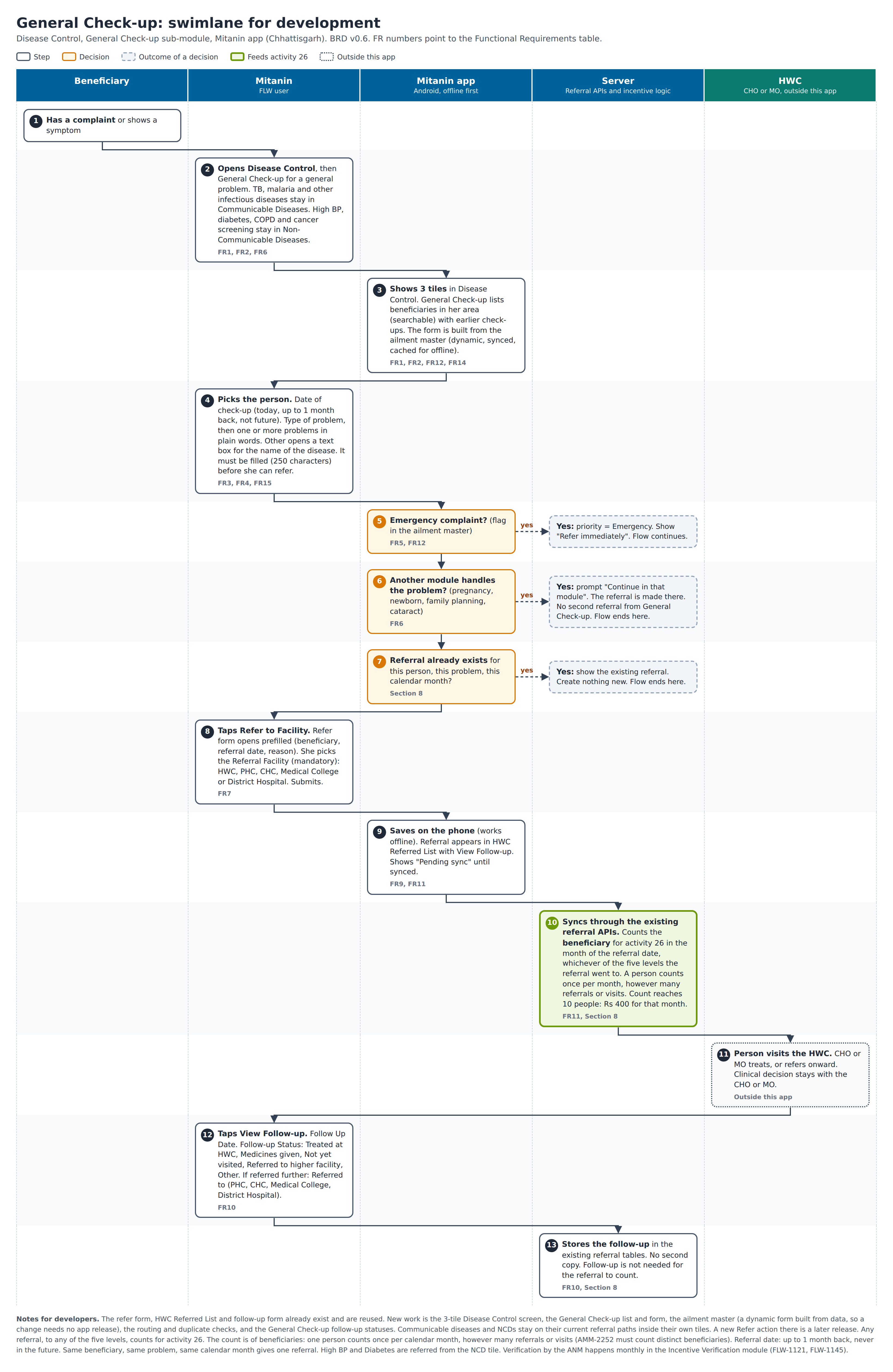
The same flow as a table, for quick search and copy:
Step | Beneficiary | Mitanin | Mitanin app | HWC | Requirement |
|---|---|---|---|---|---|
1 | Has a complaint, or the Mitanin notices a symptom | None | |||
2 | Opens Disease Control. Uses General Check-up for a general problem. Communicable diseases and NCDs stay in their own tiles | FR1, FR2, FR6 | |||
3 | Picks the person, the type of problem and one or more problems. If she picks Other, she types the name of the problem | FR3, FR4, FR5, FR15 | |||
4 (decision) | Checks whether another module handles the problem (pregnancy, newborn, family planning, cataract). If yes, prompts the Mitanin to continue there. | FR6 | |||
5 | Chooses Refer to Facility and picks the facility (HWC, PHC, CHC, Medical College or District Hospital) | FR7 | |||
6 | Opens the refer form prefilled, saves offline and syncs when online | FR7, FR11 | |||
7 | The person visits. The CHO or MO treats, or refers onward. Outside this app. | None | |||
8 | Records the follow-up and the outcome | FR9, FR10 | |||
9 | Counts the beneficiary for activity 26 in the month of the referral date, once per month, whichever facility the referral went to | Section 8 |
7. Functional Requirements
ID | Requirement | Reuses |
|---|---|---|
FR1 | Disease Control shows 3 tiles: General Check-up, Non-Communicable Diseases, Communicable Diseases. The existing tiles open from their new home, with nothing changed inside them. | Existing modules |
FR2 | General Check-up opens a searchable list of beneficiaries in the Mitanin's area. | All Beneficiaries list |
FR3 | The Mitanin adds a check-up for a beneficiary with the date. | None |
FR4 | The Mitanin picks a type of problem and then one or more problems from the ailment master (FR12). Other is always available. Selecting Other opens a text box where she writes the name of the disease or problem. The text box is mandatory: she cannot refer until it is filled. | Ailment master (FR12) |
FR5 | A problem marked as an emergency (for example chest pain or very hard breathing) sets priority to Emergency and shows a Refer immediately message. | Ailment master |
FR6 | General Check-up lists only general problems. Pregnancy, newborn, family planning and cataract appear as pointers: selecting one prompts the Mitanin to continue in Maternal Health, Child Care, Eligible Couple List or the cataract referral. One episode creates one referral only. Communicable diseases and NCDs (including High BP and Diabetes) are not in the list. The form shows a short pointer to the Communicable Diseases and Non-Communicable Diseases tiles. | Existing modules |
FR7 | A Refer to Facility button opens the existing refer form. Beneficiary, referral date and reason come prefilled. The Mitanin selects the Referral Facility, which is mandatory: HWC, PHC, CHC, Medical College or District Hospital. A referral to any of them counts for activity 26. The named hospital list is not used in this version. | Refer form (FLW-856, FLW-1033) |
FR8 | The Mitanin records only the complaint and the referral. She does not record advice or treatment, which is outside her scope. | None |
FR9 | A referral appears in the HWC Referrals list with a follow-up button. | HWC Referrals list (FLW-856, FLW-1206) |
FR10 | Follow-up reuses the existing form (Follow Up Date and Follow-up Status). The Mitanin records what the person tells her at her next follow-up visit. General Check-up adds status values, including Referred to higher facility, and then asks which facility. | Existing follow-up form |
FR11 | The whole flow works offline and syncs through the existing referral APIs. | AMM-1909, AMM-1920 |
FR12 | The check-up form is a dynamic form. It is built from the ailment master at run time, not fixed in the app code. See the developer note below. Product or ops can add, hide, rename, reorder or move a problem without an app release. Ops changes the master through a controlled sheet upload. | New |
FR13 | All labels show in Hindi and English. | Existing translations |
FR14 | A beneficiary's earlier check-ups show in a short history before a new one is added. | None |
FR15 | Every type of problem, problem and button uses plain everyday words, at about a 10th grade reading level, in Hindi and English. A medical term stays only where Mitanins already use it (for example TB or BP). Field staff review the wording before release. | Ailment master (FR12) |
FR16 | Deferred to a later release. A Refer to Facility action inside the Non-Communicable Diseases and Communicable Diseases tiles, for the conditions that are not in General Check-up. Until it is built, those cases stay on the referral paths their modules have today. | Not built in this release |
Developer note: dynamic form approach (FR12)
Build the check-up form from data, so a future change to the ailment list is a data change, not an app release.
The app gets the ailment master from a server API at sync and keeps a copy on the phone. Offline, it uses the saved copy.
The form shows the master as it is: the types of problem, the problems under each type, their labels in Hindi and English, and their order.
Rules that this BRD states for individual problems are fields in the master, not code branches: the emergency flag, the owning module and the mandatory text box for Other.
A new type of problem, a new problem, a rename, a new order, or moving a problem to another type needs no release.
Hiding a problem removes it from new check-ups. Old check-ups keep the label they were saved with.
Each saved check-up stores the problem ID and a copy of the label shown at that time.
The master carries a version number. The app downloads a new version at its next sync.
Ops edits the master with a controlled sheet upload. Ops sends the changed sheet and approves the content. The backend checks the sheet and loads it. It rejects a sheet with a missing label, a duplicate ID, a problem under an unknown type, or Other without the requires-text flag. No admin screen is built in this version.
Ailment master fields:
Field | Purpose |
|---|---|
Group ID, group label (English, Hindi), group order | The type of problem shown in the first dropdown |
SHSRC group number | Links the type of problem back to the Box 2.2 service group (Appendix A). Empty for a type added from the field list. |
Problem ID, problem label (English, Hindi), problem order | One option under a type of problem |
Emergency flag | Sets priority to Emergency and shows Refer immediately |
Owner module | Empty for a general problem. Set to Maternal Health, Child Care, Eligible Couple List or Cataract for a pointer (FR6) |
Requires text | True for Other. Opens the mandatory text box |
Active flag | False hides the problem from new check-ups |
Version | Master version number |
Check-up form fields
Field | Type | Rule |
|---|---|---|
Beneficiary | Auto | Picked from the list |
Date of check-up | Date | Default today. Cannot be a future date. Can go back up to one month (Section 11, item 4). |
Type of problem | Dropdown | One of the types in Appendix A. Mandatory. |
What is the problem? | Multi-select | At least one. |
Write the name of the problem | Text | Shown when Other is selected. Mandatory. Up to 250 characters. The check-up and the referral cannot be saved while it is empty. |
Priority | Auto | Routine. Emergency when an emergency problem is selected. |
Refer to Facility | Button | Opens the refer form (FR7) |
Follow-up fields
Field | Type | Rule |
|---|---|---|
Follow Up Date | Date | Mandatory. Cannot be before the referral date. Existing field. |
Follow-up Status | Dropdown | Mandatory. Existing field. Values for General Check-up referrals: Treated at HWC, Medicines given, Not yet visited, Referred to higher facility, Other. Confirmed by Pithora on 9 Oct 2026. |
Referred to | Dropdown | Shown only when the status is Referred to higher facility. Same referral levels as the refer form, without HWC: PHC, CHC, Medical College, District Hospital. |
8. Business and System Logic
Area | Rule |
|---|---|
Routing order | General Check-up lists only general problems. A complaint goes to the module that owns it: (1) pregnancy, delivery or postnatal care to Maternal Health; (2) newborn or infant care to Child Care; (3) family planning to the Eligible Couple List; (4) cataract to the existing cataract referral; (5) TB, Malaria, Kala Azar, AES/JE, Filaria, Leprosy and other communicable diseases (for example HIV, hepatitis) to Communicable Diseases; (6) High BP, Diabetes, COPD, cancer screening and CBAC to NCD; (7) everything else to General Check-up. Items 1 to 4 show in General Check-up as pointers. Items 5 and 6 are not in the list. The form points the Mitanin to those two tiles. |
Counting unit | Activity 26 counts beneficiaries, not referrals. A beneficiary counts once per calendar month, however many referrals or visits there are, from any module, for any problem and to any facility level. Decided, Section 11 item 10. |
One episode, one referral | The same beneficiary, the same complaint and the same calendar month give one referral. If another module has already created the referral, General Check-up shows it and does not create a second. A referral for a different problem is allowed. It does not add to the count if the beneficiary is already counted that month. |
What counts for activity 26 | Every referral with a referral date in the calendar month, whatever the Referral Facility is (HWC, PHC, CHC, Medical College or District Hospital), whether made from General Check-up or from another module that writes to the HWC Referrals list. The beneficiary counts once. Decided, Section 11 items 1, 8 and 10. |
Payout | Rs 400 when the number of counted beneficiaries in the month reaches 10, as built in AMM-2252. AMM-2252 must count distinct beneficiaries across all referral sources and all five facility levels, not rows or only referrals where the facility is HWC. A re-test is needed with General Check-up referrals included. |
Month of credit | The incentive goes to the month of the referral date, not the month of submission. A referral date can be up to one month back and never in the future. This matches AMM-2427 (closed) and AMM-2428 (Pending QA). |
Verification | The ANM reviews the claim in the monthly verification module (FLW-1121, FLW-1145). |
Emergency | An emergency problem sets priority to Emergency on the referral. The Mitanin sees Refer immediately. |
Onward referral | The CHO or MO decides on referral to a higher facility. The app records the outcome (FR10) and shows no clinical criteria to the Mitanin. |
Ailment master changes | A change reaches the Mitanin at her next sync. Check-ups already saved keep the label they were saved with (FR12). |
9. Data, Audit and Access
Attribute | Description |
|---|---|
Check-up ID | Unique per check-up |
Beneficiary ID and Mitanin ID | Who was checked and who recorded it |
Date of check-up | As entered |
Ailment group and complaints | Stored as the master ID and the label shown at that time, so later renames do not change old records |
Other problem text | The name the Mitanin typed when she chose Other. Mandatory when Other is selected. |
Priority | Routine or Emergency |
Referral ID | Link to the HWC referral, if one was made |
Created, updated and synced time | System generated |
Referral and follow-up data stay in the existing referral tables. No second copy is kept.
Access. The Mitanin sees only the beneficiaries in her own area. The ANM sees referrals in the monthly verification module for the Mitanins mapped to her.
Reporting. A monthly count per Mitanin of referrals and of distinct beneficiaries referred, split by source module and type of problem, so the ANM and programme team can see what makes up the count of 10. Other problem texts are reported so ops can see which names to add to the ailment master.
10. Acceptance Criteria
- Disease Control shows exactly 3 tiles: General Check-up, Non-Communicable Diseases, Communicable Diseases (FR1).
- NCD, Malaria, Kala Azar, AES/JE, Filaria, Leprosy and TB open as before from their new tile, with counts intact (FR1).
- A Mitanin can add a check-up for any listed beneficiary with no network, and it syncs when the network returns (FR11).
- The types of problem and the problems under them come from the ailment master. A problem added, renamed, reordered or hidden in the master changes the form after the next sync with no app release. A hidden problem disappears from new check-ups, and old check-ups keep their saved label (FR4, FR12).
- Selecting an emergency problem sets priority to Emergency and shows Refer immediately (FR5).
- Selecting a pregnancy, newborn, family planning or cataract problem prompts the Mitanin to continue in that module, and no second referral is created (FR6).
- Refer to Facility opens the refer form prefilled. The Referral Facility dropdown lists HWC, PHC, CHC, Medical College and District Hospital, and the form cannot be submitted without one (FR7).
- A referral from General Check-up appears in HWC Referrals with a follow-up button after sync (FR9).
- Follow-up saves the HWC visit and any onward referral (FR10).
- Two referrals for the same beneficiary and the same problem in one month give one referral (Section 8).
- 10 different beneficiaries referred in a month generate Rs 400 in that month. 9 generate nothing.
- A referral is credited to the month of its referral date, whichever day it is submitted.
- All labels show correctly in Hindi and English (FR13).
- A referral to PHC, CHC, Medical College or District Hospital counts for activity 26 in the same way as an HWC referral. A beneficiary referred more than once in a month, from any module, to any level, counts once. For example, 9 beneficiaries with 12 referrals between them count as 9 and generate nothing (Section 8).
- Selecting Other opens a text box for the name of the problem. Refer to Facility cannot be used until the box has text (FR4).
- Communicable diseases and NCDs, including Hypertension and Diabetes, are not in the General Check-up list. The form points the Mitanin to the Communicable Diseases and NCD tiles (FR6).
- Field staff have read the Hindi and English names of the types and problems and confirm Mitanins understand them (FR15).
- A sheet with a missing label, a duplicate ID, a problem under an unknown type, or Other without the requires-text flag is rejected. A valid sheet loads and reaches the app at the next sync (FR12).
11. Assumptions and Items for Confirmation
Assumptions
Box 2.2 is the final ailment scope. SHSRC has given the 12 service groups and no further detail. This BRD places every one (Appendix A).
The problems listed under each type in Appendix A are working examples. They come from the SHSRC group names and from the common diseases list Pithora sent. They live in the ailment master (FR12), so they can be edited without a release.
Anaemia, Jaundice, Thyroid problem and Sickle cell disease sit in General Check-up under Blood, thyroid and jaundice. If ops classes Thyroid or Sickle cell as an NCD, they move to the NCD tile.
The CHO or MO decides on onward referral. The app records the outcome.
Until FR16 is built, referral for communicable diseases and NCDs continues on the paths those modules have today.
Items raised, with decisions
# | Question | Needed from | Decision |
|---|---|---|---|
1 | Do HWC referrals from CBAC, TB and ANC count towards activity 26, or only referrals made from General Check-up? | Ops | All HWC referrals count, from any module. |
2 | Must a referral have a recorded follow-up to count? | Ops | No. A referral counts from the day it is created. Follow-ups are recorded separately in the HWC Referred List. |
3 | Jaswant's report asks for criteria to refer from the HWC to a higher facility. Is recording the HWC outcome (FR10) enough for v1? | Jaswant Kumar | Yes for v1. The app records what the HWC did, including any onward referral. It shows no clinical criteria. |
4 | Can a Mitanin enter a referral dated in the previous month, and until which cut-off? This links to the open decision on AMM-2428 and to the cut-off dates in FLW-1012. | Ops, product | Up to one month back. Credit goes to the month of the referral date. No future dates. |
5 | How does the Home screen's General OPD Care List tile relate to General Check-up? Does it stay, merge or move? | BSA, product | The tile is redundant. No link to General Check-up. |
6 | Is the Refer immediately message enough for an emergency, or should the app also show an emergency contact number? | Ops | The Refer immediately message is enough. No call button. |
7 | Who owns the ailment master and approves changes to it? | Product, ops | Ops verifies the list and approves changes. SHSRC is contacted only if ops needs more confirmation. |
8 | Do referrals to PHC, CHC, Medical College and District Hospital count towards activity 26, or only referrals to the HWC? | Ops, SHSRC | A referral at any of the five levels counts. Confirmed by SHSRC through Jaswant Kumar on 9 Oct 2026. AMM-2252 must be checked and changed if it counts only the HWC. |
9 | What should the submit button say, given the facility can be any of five levels? | Product | Refer to Facility. The Mitanin then selects the facility. The referral counts whichever she picks. |
10 | If a beneficiary is referred or visited more than once in a month, how does it count for activity 26? This also answers the ops question on one referral per problem or one per beneficiary. | Ops, Pithora | A beneficiary counts once per month, however many referrals or visits, from any module, for any problem and to any level. Source: Jaswant Kumar. Ops may still correct this. |
11 | Should communicable disease and NCD referrals stay in General Check-up? | BSA, ops feedback | No. They are not in the General Check-up list. They stay on their current paths inside their own tiles. A new Refer action in those tiles is a later release (FR16, deferred). High BP and Diabetes from Jaswant's list go to the NCD tile only. |
12 | Are the ailment names simple enough for Mitanins? | BSA, ops feedback | Names are rewritten in plain everyday words at about a 10th grade reading level, in Hindi and English (FR15). |
13 | How should Jaswant's list of 18 common diseases join the working list? | BSA | Merged into the existing types, keeping Type of problem. Two types are added (Injury and bites; Blood, thyroid and jaundice). Other is available under every type, and a Something else type holds a single Other (Appendix A). |
15 | What does the Mitanin pick when she refers? A government hospital list already exists in the app. | BSA | Five levels only: HWC, PHC, CHC, Medical College, District Hospital. The named hospital list is not used in this version. |
16 | Who specifies and builds a Refer to Facility action inside the NCD and Communicable Diseases tiles (FR16)? | BSA | Parked. Not part of this release. Those tiles are only regrouped under the 3-tile screen (FR1). |
17 | How does ops edit the ailment master? | BSA | Controlled sheet upload. Ops approves the content. The backend validates the sheet and loads it. No admin screen in this version. |
Field confirmation from Pithora (Jaswant Kumar)
# | Question | Response |
|---|---|---|
1 | How does the Mitanin find out what happened after the HWC visit? | She learns it at her next follow-up visit with the beneficiary. The follow-up records what the person tells her. Mitanins can identify diseases during follow-up visits. |
2 | Where does the HWC send people onward? | The listed levels are correct: PHC, CHC, Medical College, District Hospital. A referral at any of these levels counts for activity 26 (item 8). |
3 | Are the follow-up outcomes right? | Yes. Treated at HWC, Medicines given, Not yet visited, Referred to higher facility, Other are confirmed as listed. |
4 | Is there a government hospital list? | Yes. It is in the FLW app under the multiple-form section. Not used in this version (item 15). |
5 | Are the proposed changes acceptable? | Yes. The proposed changes are good to go. |
6 | Which diseases should be included? | Fever, Common Cold, Cough, Headache, Diarrhoea, Constipation, Acidity, Skin Diseases, Eye Infections, Anaemia, Hypertension (High Blood Pressure), Diabetes, Thyroid Disorders, Jaundice, Minor Injuries (Accidents and Incidents), Animal Bites, White Discharge, Sickle Cell Disease. From Tukeshwar Sahu's inputs. Placement is in Appendix A. |
7 | What if a disease is not listed? | An Other option lets the Mitanin type the name of any disease not listed (FR4). |
8 | How should beneficiaries be counted? | Each Mitanin should count a beneficiary only once per month, even if the beneficiary is visited multiple times in the month (item 10). |
Still open
# | Question | Needed from | Status |
|---|---|---|---|
14 | Ops sign-off on the final General Check-up list and on the split with the Communicable Diseases and NCD tiles. Field has confirmed the proposed changes and sent the common diseases list (field items 5 and 6). | Ops | Awaiting ops |
Appendix A: Where Every Ailment Sits
Every one of the 12 service groups in Box 2.2 has a home in the app. General Check-up carries 8 of them (groups 3, 4, 6, 8, 9, 10, 11 and 12). Groups 1 and 2 stay in Maternal Health and Child Care. Groups 5 and 7 stay in the Communicable Diseases tile and the NCD tile, on the paths those modules have today. Two more types come from the field list (Injury and bites; Blood, thyroid and jaundice), and one catch-all (Something else) holds a single Other. The names in the third column are the words the Mitanin sees. The problems listed are working examples that seed the ailment master (FR12) and are awaiting ops sign-off (Section 11 item 14).
# | HWC service group (SHSRC) | Shown to the Mitanin as | Problems shown (working examples) | Sits in | How the Mitanin refers |
|---|---|---|---|---|---|
1 | Care in pregnancy and child-birth | Pointer only: Pregnant woman with a problem | ANC, danger signs in pregnancy, delivery, postnatal care, high-risk pregnancy | Maternal Health (existing) | Danger-sign referral already exists (FLW-672). A pregnant woman with a problem is routed here. |
2 | Neonatal and infant health care | Pointer only: Newborn (under 28 days) is sick | HBNC and HBYC visits, newborn and infant danger signs | Child Care (existing) | HBNC and HBYC danger-sign triggers refer to the HWC (FLW-1106). |
3 | Childhood and adolescent health care | Child and teenager health | Child has fever, cough or cold, loose motions, a skin or ear problem. Teenager has a health worry. Immunization, growth and SAM stay in their modules. | General Check-up for illness. Child Care and Routine Immunization for the rest. | Refer to Facility from General Check-up. |
4 | Family planning, contraceptive and other RCH services | Women's health and family planning | Periods problem, white discharge, itching or burning in private parts. Pointer: family planning advice or sterilisation. | Eligible Couple List for family planning. General Check-up for reproductive health problems. | Refer to Facility from General Check-up. |
5 | Management of communicable diseases including National Health Programmes | Not in General Check-up. A pointer on the form sends the Mitanin to the Communicable Diseases tile. | TB, Malaria, Kala Azar, AES/JE, Filaria, Leprosy. Other communicable diseases with no form in the app today (for example HIV, hepatitis). | Communicable Diseases tile | Stays on the path each module has today. A new Refer action in the tile is a later release (FR16). |
6 | Common communicable diseases and OPD care for acute simple illnesses and minor ailments | Fever, cough and common illness | Fever, common cold, cough, sore throat, headache, loose motions (diarrhoea), vomiting, stomach pain, constipation, acidity, skin disease | General Check-up (core) | Refer to Facility from General Check-up. |
7 | Screening, prevention, control and management of NCDs | Not in General Check-up. A pointer on the form sends the Mitanin to the NCD tile. | CBAC screening, High BP (Hypertension), Diabetes, COPD, oral, breast and cervical cancer | NCD tile | Stays on today's path. CBAC referral already exists (6 types). A new Refer action in the tile is a later release (FR16). |
8 | Care for common ophthalmic and ENT problems | Eye and ear problems | Eye infection, blurred vision, ear pain, pus or water from the ear, cannot hear well, nose bleeding. Pointer: cloudy eyesight (may be cataract). | General Check-up. Existing cataract referral stays. | Refer to Facility from General Check-up. |
9 | Basic oral health care | Teeth and mouth | Toothache, bleeding gums, sore in the mouth. Oral cancer screening stays in CBAC. | General Check-up | Refer to Facility from General Check-up. |
10 | Elderly and palliative health care | Older people (60 years and above) | Fall or injury, forgetting things, stays in bed and cannot move, long illness needing care at home | General Check-up. Existing geriatric referral stays. | Refer to Facility from General Check-up. HWC side: Elderly and Palliative BRD. |
11 | Emergency medical services | Emergency | Chest pain, very hard to breathe, serious injury or accident, burns, snake bite, poison swallowed, fits, heavy bleeding | General Check-up with priority Emergency | Refer immediately. Priority Emergency shows on the referral (FR5). |
12 | Screening and basic management of mental health ailments | Mental health (mind and mood) | Cannot sleep, feeling sad or low for many days, fear or worry, fits, forgetting things, alcohol or tobacco habit | General Check-up for problems. CBAC for depression screening. | Refer to Facility from General Check-up. HWC side: Mental Health Module BRD. |
Added | From the field list, no single SHSRC group | Injury and bites | Minor injury or accident (cut, fall, bruise), animal bite (dog, monkey or other) | General Check-up | Refer to Facility from General Check-up. |
Added | From the field list, no single SHSRC group | Blood, thyroid and jaundice | Anaemia, jaundice, thyroid problem, sickle cell disease | General Check-up | Refer to Facility from General Check-up. |
Added | Catch-all | Something else (not listed) | Other only. The Mitanin types the name of the disease. | General Check-up | Refer to Facility from General Check-up. |
Where each disease in the field list sits (sent by Pithora, from Tukeshwar Sahu's inputs)
Disease in the field list | Type of problem in General Check-up |
|---|---|
Fever, Common Cold, Cough, Headache, Diarrhoea, Constipation, Acidity, Skin Diseases | Fever, cough and common illness |
Eye Infections | Eye and ear problems |
White Discharge | Women's health and family planning |
Minor Injuries (Accidents and Incidents), Animal Bites | Injury and bites |
Anaemia, Jaundice, Thyroid Disorders, Sickle Cell Disease | Blood, thyroid and jaundice |
Hypertension (High Blood Pressure), Diabetes | Not in General Check-up. NCD tile, on today's path (Section 11 item 11). |
Other (any disease not listed) | Other, under every type, with a mandatory text box |
Appendix B: Related Tickets, Glossary and Sources
Related tickets (status as of 8 Oct 2026)
Ticket | What it covers | Status |
|---|---|---|
HWC Referrals list, refer form, Referral Facility dropdown | Closed | |
Referral Facility mandatory on the refer form | Closed | |
Danger-sign alert and referral for pregnant women | Closed | |
HBNC and HBYC danger signs linked to the HWC refer form | Closed | |
Follow-up button status in HWC Referrals | Open | |
TB-suspected follow-up form | Pending QA | |
Incentive logic for 10 or more HWC referrals | Closed | |
Nayi Pahal Kit incentive in the wrong month | Closed | |
NCD assessment survey incentive in the wrong month | Pending QA | |
Mitanin Trainer and ANM Incentive Verification Module | Closed | |
Configurable cut-off dates per state variant | Closed | |
To be raised | General Check-up sub-module and 3-tile Disease Control screen | New |
Glossary
Term | Meaning |
|---|---|
HWC | Health and Wellness Centre (Ayushman Arogya Mandir) |
PHC, CHC | Primary Health Centre, Community Health Centre |
CHO, MO | Community Health Officer, Medical Officer at the HWC |
ANM | Auxiliary Nurse Midwife |
CBAC | Community Based Assessment Checklist, the NCD screening form |
SHSRC | State Health Systems Resource Centre |
HBNC, HBYC | Home-Based Newborn Care, Home-Based Care for Young Child |
RCH | Reproductive and Child Health |
AES/JE | Acute Encephalitis Syndrome and Japanese Encephalitis |
Sources. Box 2.2, Expanded Range of Services, as shared by the SHSRC indicative list. Field notes from Nikhil Padhan and Jaswant Kumar, 8 Oct 2026. Layout and house style follow the Confluence BRDs linked in Section 1. The two-way referral system and the CHO's follow-up role are described on the NHSRC Ayushman Arogya Mandir page. Ticket status from Jira as of 8 Oct 2026.