Zero-Touch, Fraud-Resistant, Geo-Verified Attendance for Field Health Workers
Background and Problem Statement
PSMRI (Piramal Swasthya Management and Research Institute) runs field health programs, including TB screening under the STOP TB application, through hundreds of health workers operating across remote tribal blocks. These workers run screening camps at sites that change daily, often in locations with no cellular network, such as rural forest and tribal areas.
Attendance today is either self-reported on paper registers or captured through basic digital forms with no independent verification. This creates three concrete failure modes: one worker can mark attendance for another (proxy attendance), a worker can record presence at the camp without physically being there (location fabrication), and (manual entry) introduces transcription errors into daily reporting. Supervisors cannot close this gap through physical verification, since co-presence checks don't scale across multiple camps running at the same time, and by the time discrepancies surface during audit, weeks have usually passed.
The consequence is that PSMRI has no reliable, independently verifiable answer to a basic question: did the right worker actually attend the right camp location on the right day. That gap directly affects three things the organization is accountable for: performance monitoring of field staff, accuracy of salary disbursement, and the integrity of location data reported to donors and government stakeholders. Attendance records today carry no spatial verification layer (no link to the camp's DIGIPIN or geo-fence), no device-level check to confirm the record originated from a registered worker's device, and no mechanism to flag suspicious patterns, such as a worker checking in from two locations far apart within an implausible time window, in real time rather than after the fact.
Any solution also has to work within real field constraints that rule out most conventional approaches: no dependency on live network connectivity at the point of capture, no added steps or friction for workers who are already burdened with camp duties, and compatibility with low-spec Android tablets that may not carry a SIM.
Current Challenges
- Manual attendance registers are susceptible to falsification and retrospective filling.
- No location verification.
- Supervisor verification requires physical co-presence which is not scalable across 100+ simultaneous camp locations.
- Attendance data is not linked to the DIGIPIN of the camp location, no spatial verification layer.
Principle
Attendance capture is triggered by user login- a pre-existing, mandatory workflow step. No new button, no separate attendance form, no additional action required from the users end. The system captures location silently and displays confirmation.
2. Proposed Solution
An AI-enabled, zero-touch attendance system that auto-captures GPS coordinates, derives DIGIPIN, records device metadata, and generates a tamper-resistant attendance event on user login without requiring any manual entry. An anomaly detection layer flags suspicious patterns in real time.
Key Requirements
- Field worker opens the STOP TB application and enters login credentials.
- On user login to the application, the system shall automatically capture: GPS latitude, GPS longitude, GPS accuracy (metres), DIGIPIN, device ID (IMEI/Android ID), timestamp, network status (Offline) etc. It should work on no network areas like rural forest areas, tribal areas etc. Also capture check out time stamp.
- It should work on android tablets without sim.
- The system compares the captured GPS coordinates against the configured camp geo-fence (defined by Admin as: centre point DIGIPIN + radius in metres). The camp site is variable and is bound to change everyday but camp personnel are same.
- The AI anomaly detection engine shall flag:
(a) Impossible travel- check-in from location >50km from previous check-in within <2 hours
(b) Duplicate attendance- same user, same day, two check-ins >5km apart
(c) Outlier location- check-in >2km outside the configured camp geo-fence
(d) Device mismatch- login from unregistered devices.
- Flagged anomalies shall generate an alert in the Admin dashboard: worker name, flag type, location, timestamp. Admin can resolve (Accept / Escalate) each flag.
- Attendance record shall be stored locally in offline mode and synced to AMRIT Central servers on next connection. Time-stamped at point of capture, not at point of sync.
- The system shall capture check-out on session close or explicit logout. Session duration = check-in timestamp to check-out timestamp.
- Attendance analytics dashboard (Admin): daily attendance rate by worker, by camp, by village; geo-heat map of attendance locations; anomaly flag rate; average session duration
- The geo-fence is a configurable radius around the camp site DIGIPIN centre-
- Default radius: 500 metres (suitable for outdoor village camp settings).
- Admin can set camp radius: 100m (strict, urban settings) to 2000m (dispersed rural camps).
- Option to generate daily, weekly, monthly wise attendance reports by officials. Report should be based on State >> District >> Block level.
User Workflow
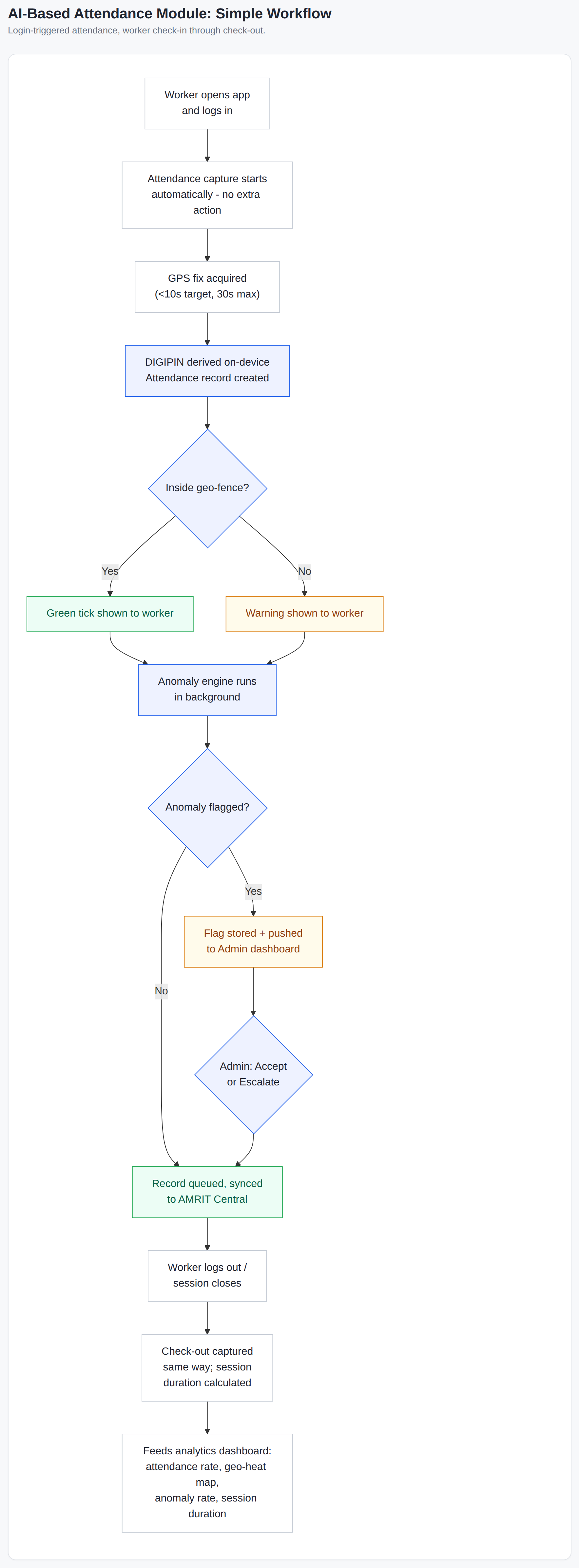
- Field worker opens the STOP TB application and enters credentials.
- On credential submission: attendance capture begins automatically (no worker action required).
- App requests GPS permission (first-time only); subsequent logins use cached permission.
- GPS fix acquired (target: <10 seconds in open-sky conditions; up to 30 seconds maximum).
- On GPS fix: DIGIPIN derived on-device (<200ms). Attendance event record created: {user_id, timestamp_utc, lat, long, digipin, accuracy_m, device_id, network_status, geofence_status}.
- Attendance confirmation shown to worker: 'Attendance recorded at [DIGIPIN]-[Timestamp]'. Green tick if inside geo-fence; warning if outside.
- Anomaly detection engine runs asynchronously: flags stored locally; pushed to Admin dashboard on sync.
- On logout or session close: check-out event recorded with same fields. Session duration calculated.
Expected Benefits and Impact
- Eliminates proxy attendance and location fabrication- program data integrity restored.
- DIGIPIN-based geo-verification provides legally defensible location records for salary disbursement and donor reporting.
- Real-time anomaly flags enable supervisors to respond within the same working day- not weeks later during audit.
- Attendance pattern analytics identify chronically absent workers, high-performing sites, and geographic coverage gaps.
- Zero additional workflow friction: attendance capture is embedded in the login step that already exists.